AI: An Operational Turning Point Your Competitors Have Already Taken
The Swiss technological landscape has evolved radically. According to recent data, the share of SMEs integrating AI into their processes rose from 22% in 2024 to 34% in 2025. It is no longer just a trend, but a ground reality: your direct competitors are already automating repetitive tasks, reducing processing times, and improving their operational profitability.
To refrain from acting is to accept leaving increasing room for maneuver to those who, thanks to AI, handle more files with the same resources. Companies like SwissCaution have already demonstrated that integrating AI into business processes not only increases productivity but also streamlines the customer experience. While you hesitate, your competitors are learning, industrializing their methods, and strengthening their competitiveness.
- 34% of Swiss SMEs now use AI to automate their workflows.
- 57% of users report a concrete improvement in their operational efficiency.
- The risk of delay: a loss of competitiveness against more agile players who are less burdened by time-consuming administrative tasks.
The Pragmatic Method: Start Small to Succeed Big
The classic mistake is wanting to automate everything at once or choosing the tool before the problem. Success relies on a targeted approach: identifying a repetitive process that consumes more than 5 hours per week. By targeting these 'quick-wins', you ensure a measurable return on investment in less than six months.
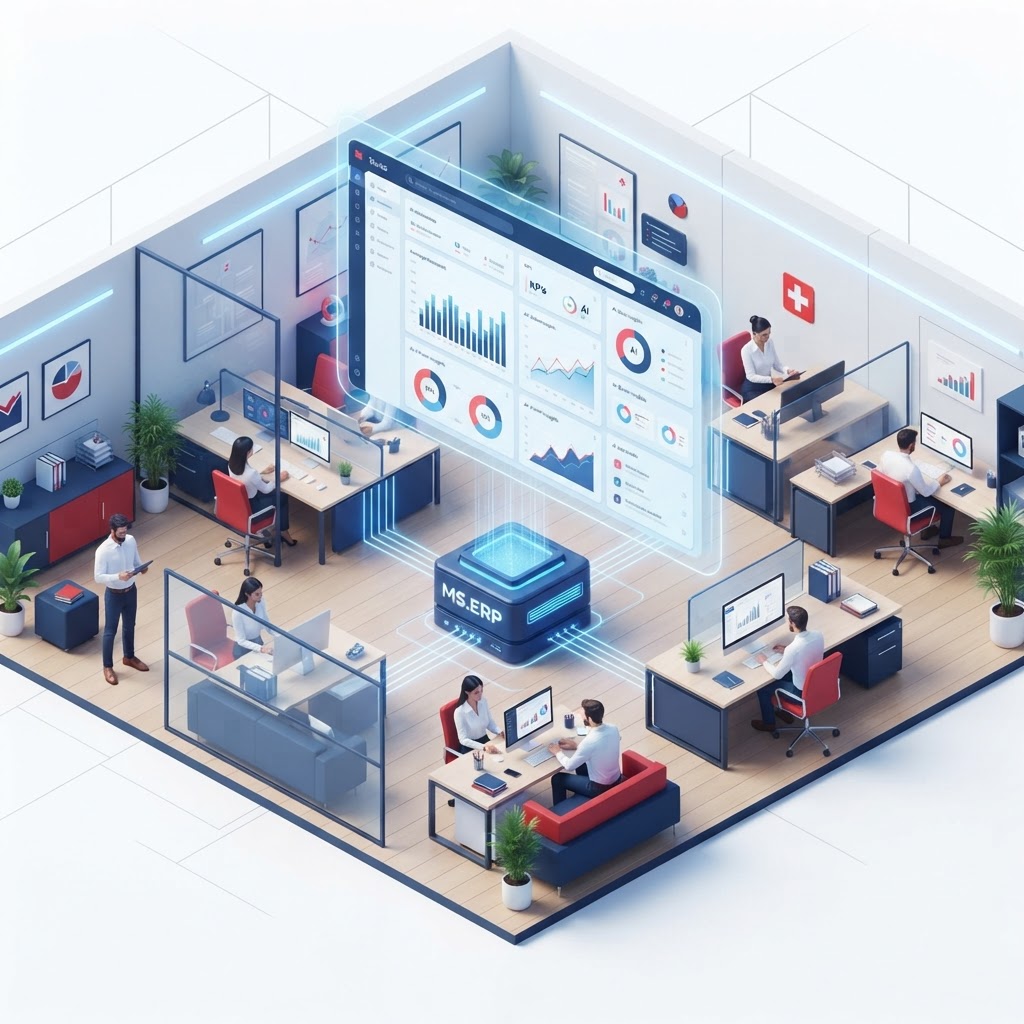
With solutions like MS.ERP, AI does not remain a disconnected black box. It integrates directly into your data ecosystem to automate entry, consistency checks, or invoice processing. The goal is to free your employees from low-value tasks so they can focus on analysis and customer relations.
- Map out time-consuming processes (≥ 5h/week).
- Select 2 to 3 high-impact pilot projects.
- Define human escalation rules for complex cases.
- Measure time savings before extending AI to other departments.
Integration at the Heart of Your ERP: The Role of MS.ERP
AI is all the more powerful when it is based on structured data. Too many SMEs suffer from silos where the ERP, Excel files, and emails do not communicate. MS.ERP acts as the foundation of this transformation by centralizing your data, thus allowing AI to act with precision on your actual workflows.
Whether for financial management, HR, or operations, our agentic AI tools attach themselves to your existing processes. They do not replace your teams; they augment them. By automating compliance checks or document preparation, you reduce human errors while guaranteeing total traceability, which is essential for executives and CFOs.
- Data centralization for relevant and contextual AI.
- Automation of administrative tasks (invoicing, entry, follow-ups).
- Human supervision maintained to ensure quality and compliance.
Summary: Taking Action is a Strategic Necessity
The conclusion is clear: AI has become a performance engine for Swiss SMEs. Your competitors are already using it to optimize their costs and responsiveness. Waiting means taking the risk of being left behind by companies that have already automated their key processes.
The key to success does not lie in technological complexity, but in the rigor of implementation. By starting with measurable pilot projects and relying on a robust ERP like MS.ERP, you transform your daily management into a lever for sustainable growth. It is time to move from observation to action.
- AI is a profitability lever, not just a gadget.
- The competition is moving ahead: automation is already a sector reality.
- Start with a specific process, measure, then expand.